January, half past five in the morning. One valve opens in the bathroom and the boiler fires up. Two minutes later it goes out, because it has nowhere to send the hot water. A little later it tries again. And again. You sleep through it. The boiler doesn’t.
Valves that don’t talk to the heat source can shorten its life.
A smart valve can’t heat by itself
A valve on a radiator or on the underfloor heating manifold does one thing: it lets hot water into the room, or it doesn’t. The heat comes from the boiler or the heat pump. As long as they don’t know about each other, each one controls something different: the valve the room temperature, the boiler the water temperature. Nobody controls the heating as a whole.
That is exactly what happens with valves that each decide for themselves — whether they’re battery valves with an app or separate thermostats in each room. The boiler then keeps heating even when most of the house is shut off. The water heats up in a few minutes, the burner goes out, the water cools, the burner lights again. Heating engineers call it short cycling.
What one start costs
For a boiler, starting up is the hardest part of the whole job:
- The fan first purges the combustion chamber. Whatever heat was left in it goes up the chimney.
- The ignition electrode sparks and the gas valve opens. Both wear with use.
- The heat exchanger heats up sharply and a few minutes later cools down again. Metal doesn’t take kindly to that kind of back and forth.
- The pump, meanwhile, pushes water against closed valves.
Viessmann’s German heating portal heizung.de sums up what short cycling leads to: the heating wears out faster, uses more energy and emits more pollutants. With older boilers, it says, the burner can easily fire up every ten minutes in spring and autumn. That’s over a hundred starts a day.
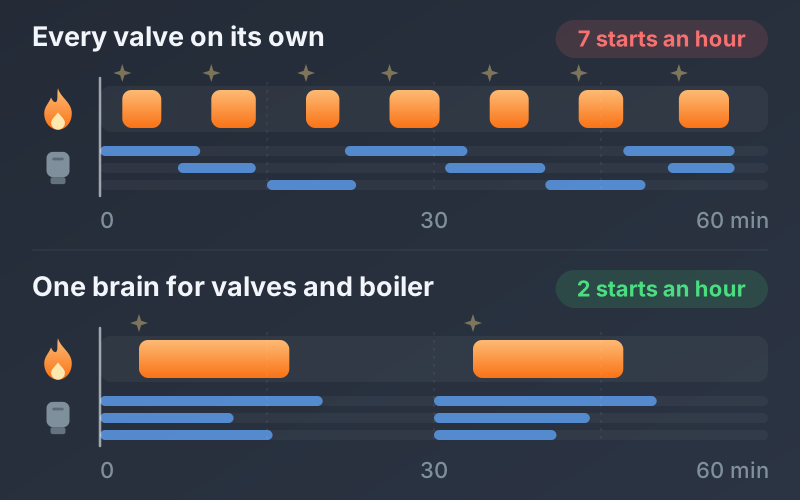
An illustration of one hour with the same heat demand. Top: every valve on its own, not talking to the boiler. Bottom: one brain for valves and boiler.
With a heat pump, frost is the risk
An air-to-water heat pump is even more sensitive to closed valves. While it runs, it needs water flowing through it. And in winter it defrosts its outdoor unit every now and then — taking the heat for that from the heating water in the house.
If every circuit is closed at that moment, there is nothing to take it from. The design guidelines from GT Energy, a Czech heat-pump company, put it bluntly: the minimum volume of heating water must not be restricted by the controls, for example by a valve on the manifold, otherwise you risk a fault, or even a frozen and wrecked heat exchanger. That’s why heat pumps get a buffer tank, or some circuits are left permanently open. And then those rooms are heated whether anyone wants it or not.
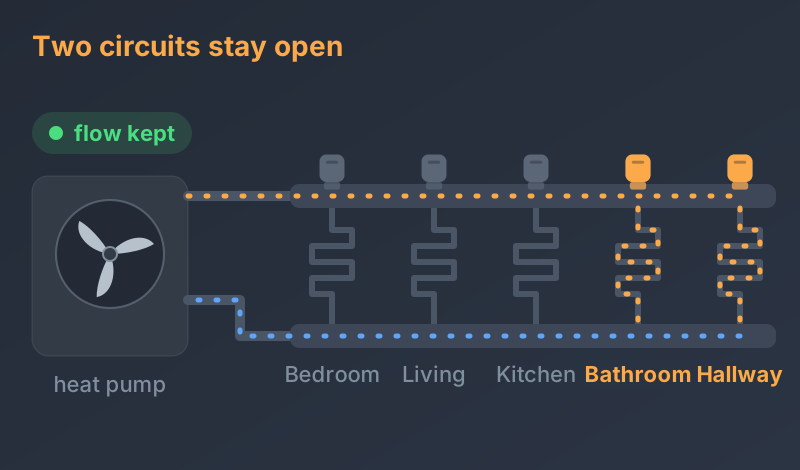
When all the valves close, the water stops. So BARAQ keeps circuits open where a little extra heat does no harm.
One brain for the valves and the heat source
BARAQ’s answer is simple: the valves, the boiler and the heat pump are all run by one control unit, the ioMASTER. It knows which valve is open, how long it takes to open and what the heat source is doing right now. With that, it keeps an eye on the timing:
- The boiler is only called once a circuit is open. A thermoelectric valve takes several minutes to open. Only then does the boiler switch on.
- If it heats, it heats properly. A call for heat lasts at least ten minutes, and there’s a pause of at least five minutes between two calls. So the boiler never gets the command to switch on more than four times an hour.
- The valves open together. The rooms start their heating cycle at the same moment, so the boiler gets the demand in one go, not in dribs and drabs.
- Small needs are saved up. When a room is only a little short of heat, it doesn’t get ten short doses but one longer one. In a simulation with one room, that works out at roughly one boiler start an hour.
- The pump has somewhere to run on. After the boiler switches off, the last circuit stays open for another three minutes.
- The heat pump always has a way through. The system keeps a minimum number of circuits open — the bathroom and the hallway first, where extra heat does no harm, bedrooms last. Circuits that happen to be heating anyway count towards it.
A gas boiler needs nothing special for this — BARAQ switches the ordinary room-thermostat contact. How long the burner actually fires during a call is up to the boiler itself, based on the water temperature; that’s one more reason BARAQ sends it the demand in one go. Flow protection works with a heat pump that is connected to the system and reports its status to it.
That’s how the system is set up from day one. You can change every value in the app to suit the boiler and valves you actually have.
| What it watches | Default |
|---|---|
| Heating cycle length | 15 min for underfloor heating, 10 min for radiators |
| Shortest valve opening | 5 min |
| Shortest valve pause | 2 min |
| Shortest call to the boiler | 10 min |
| Pause between calls to the boiler | 5 min |
| Pump overrun | 3 min |
| Circuits kept open for a heat pump | about a third, at least 2 |
| Valve exercise so it doesn’t seize | once a week |
Once a week, every valve gets a stretch
A valve that hasn’t moved for six months is prone to seizing. That’s why TZB-info, a Czech building-services portal, advises against leaving valves closed over the summer. BARAQ doesn’t leave it to chance: any valve that hasn’t moved for a week is opened for a few minutes and closed again. It does this during the day, so the click wakes nobody — and so nobody has to free the valve with pliers in the autumn.
The dial you know from your radiator
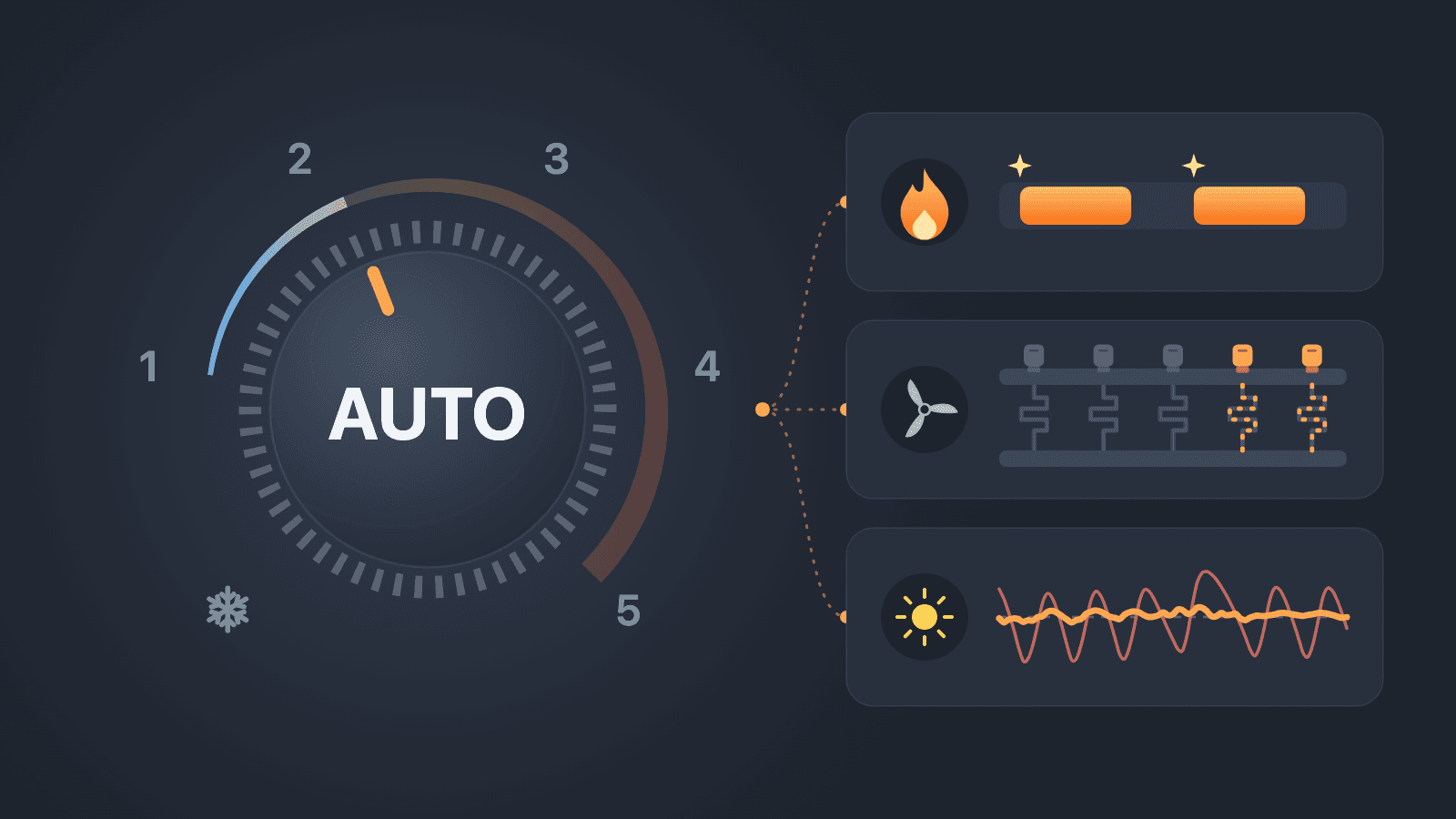
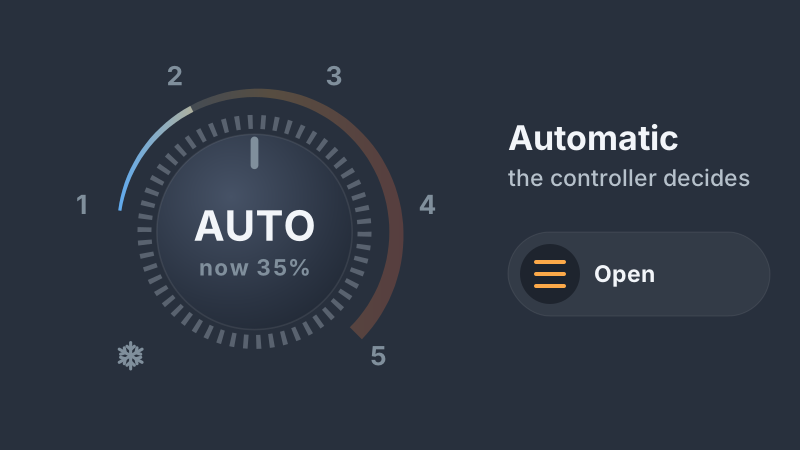
In the app, every valve has a dial like an old manual radiator valve: a snowflake and the numbers 1 to 5. Most of the time it shows AUTO and the controls decide how much heat goes in. When you want to heat a room up for once, or shut it off, you tap a setting. The valve’s tile then carries a “Manual” tag so it doesn’t get forgotten, and one button takes it back to automatic. The valve’s chart shows when it was open and how far.
Every room is learnt separately
A bathroom with a small floor behaves differently from a living room with a window across the whole wall. So the controls note down a few numbers for every room:
- How fast it cools — how much heat it needs for every degree of difference between inside and out.
- How long the heat takes to arrive — a radiator responds in minutes, a floor in tens of minutes.
- How much is still to come — a floor keeps giving off heat after the valve closes, so the system eases off early.
- What the sun will do — from the weather forecast, which way the windows face and how the blinds are angled right now. A room without blinds works out for itself, by watching, at which hours the sun lends a hand.
The type of room matters elsewhere too: when something has to stay open for the heat pump, the system picks the bathroom or the hallway, not a bedroom.
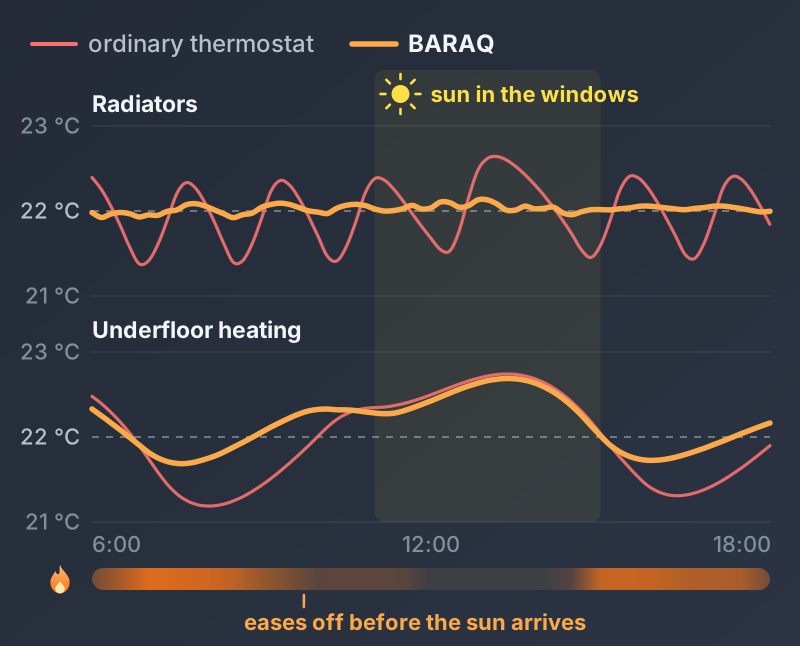
A model sunny winter day, target temperature 22 °C. Calculated on a simplified model of a room, not a measurement in a house.
The model also shows an honest limit. Radiators can be held almost flat. A concrete floor is slow, and no control can hide what the midday sun does to it — the difference is that the temperature doesn’t sag by a degree in the meantime.
How much will it save? An estimate, not a promise
Smooth control doesn’t make heat any cheaper. It saves in other ways:
- You don’t need an extra degree just in case. An ordinary thermostat lets the temperature swing, and people turn it up because of the dips. In our model, smooth control keeps the lowest temperature about half a degree higher at the same setting. And Chytrá volba, the Czech Ministry of Industry and Trade’s energy-advice portal, says each degree lower is worth roughly 6% of heating costs.
- No heating against the sun. What the sun brings in through the window, the boiler doesn’t have to.
- The boiler heats in longer runs. Part of the losses from short starts, which boiler makers link to higher consumption, falls away.
Together with the heating plan, we expect savings in single-digit percentages, roughly 5–10% of the energy used for heating. It’s the same range we give elsewhere on this site. It depends on the house, the heat source and how you’ve been heating so far. We don’t have our own measurements from a whole heating season yet, which is why we call it an estimate. We don’t promise a specific amount.
What to ask before you buy smart valves
A smart valve isn’t a bad thing. What’s bad is a house where nobody sees the whole picture. Before you get valves — from us or from anyone else — ask three questions:
- Does the heat source know which valves are open right now?
- Who keeps an eye on how long the boiler runs and how often it fires up?
- What happens when all the valves close at once?
Your heating is one system. The valves, the boiler and the heat pump should all answer to one brain that looks after both the timing and the protection.
Building or renovating? The best time for these questions is before the electrical design. That’s when it’s decided where the cables to the manifold and the boiler will run.
Sources
- heizung.de (Viessmann): Modulation – Regulierung der Heizleistung (in German)
- GT Energy: Akumulační (taktovací) nádoba pro tepelné čerpadlo (in Czech)
- TZB-info: Nečekejte na topnou sezonu. Problémy s termostatickou hlavicí řešte včas (in Czech)
- Chytrá volba (MPO): Vytápění a regulace teploty (in Czech)