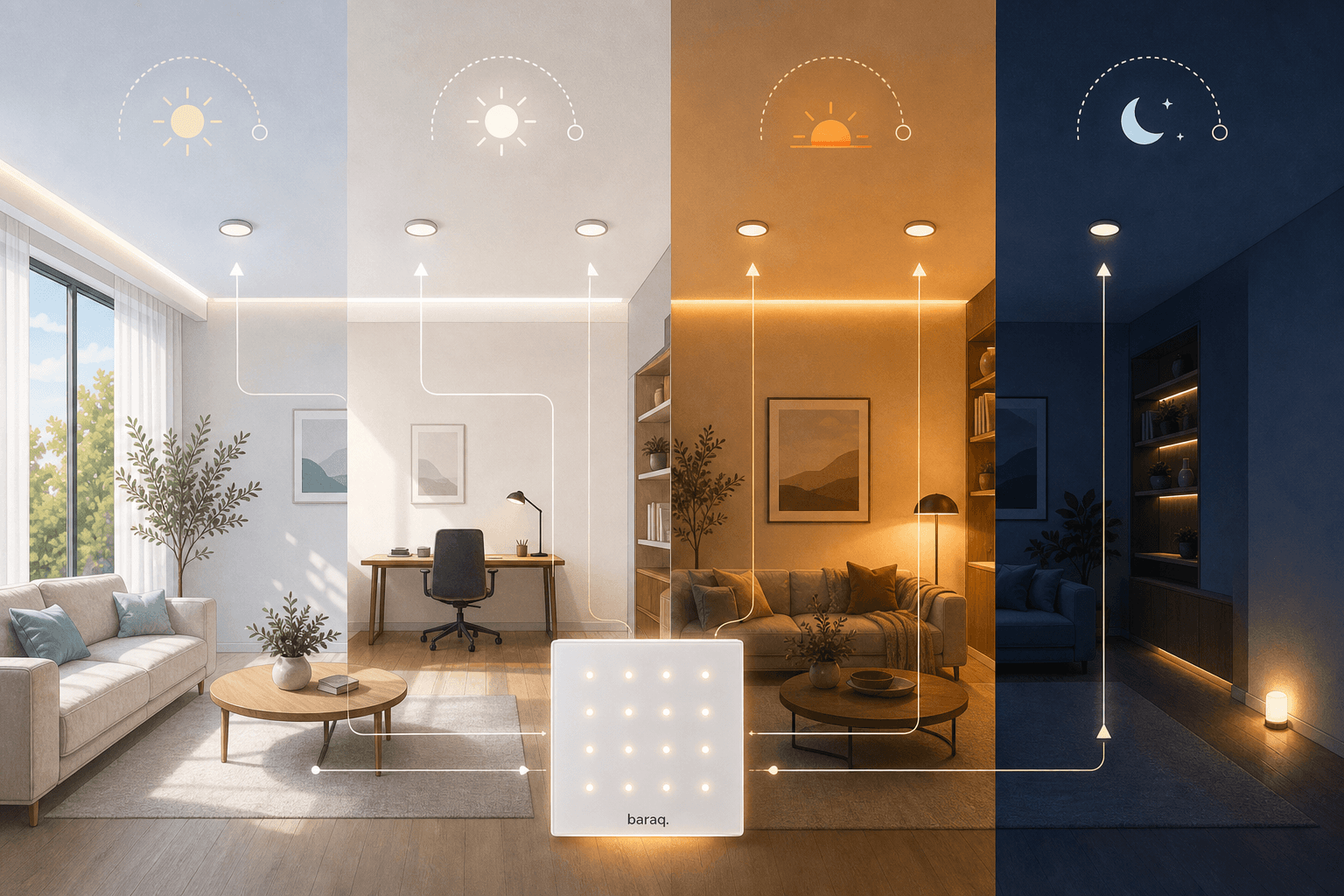
The same room can be for a quick start in the morning, for work in the afternoon, for unwinding in the evening and, at night, just for getting through safely. If it always has the same light, you have to adapt to the house. Smart lighting can turn that round: the light adapts to what you’re doing.
What adjustable colour temperature means
With ordinary lights we usually only deal with brightness: more light or less. Adjustable colour temperature adds another layer. The light can be more neutral and brighter during the day, or warmer and softer in the evening.
It isn’t an effect for the sake of it. Well-set light helps a room feel more natural. The kitchen in the morning doesn’t need the same mood as the living room before bed.
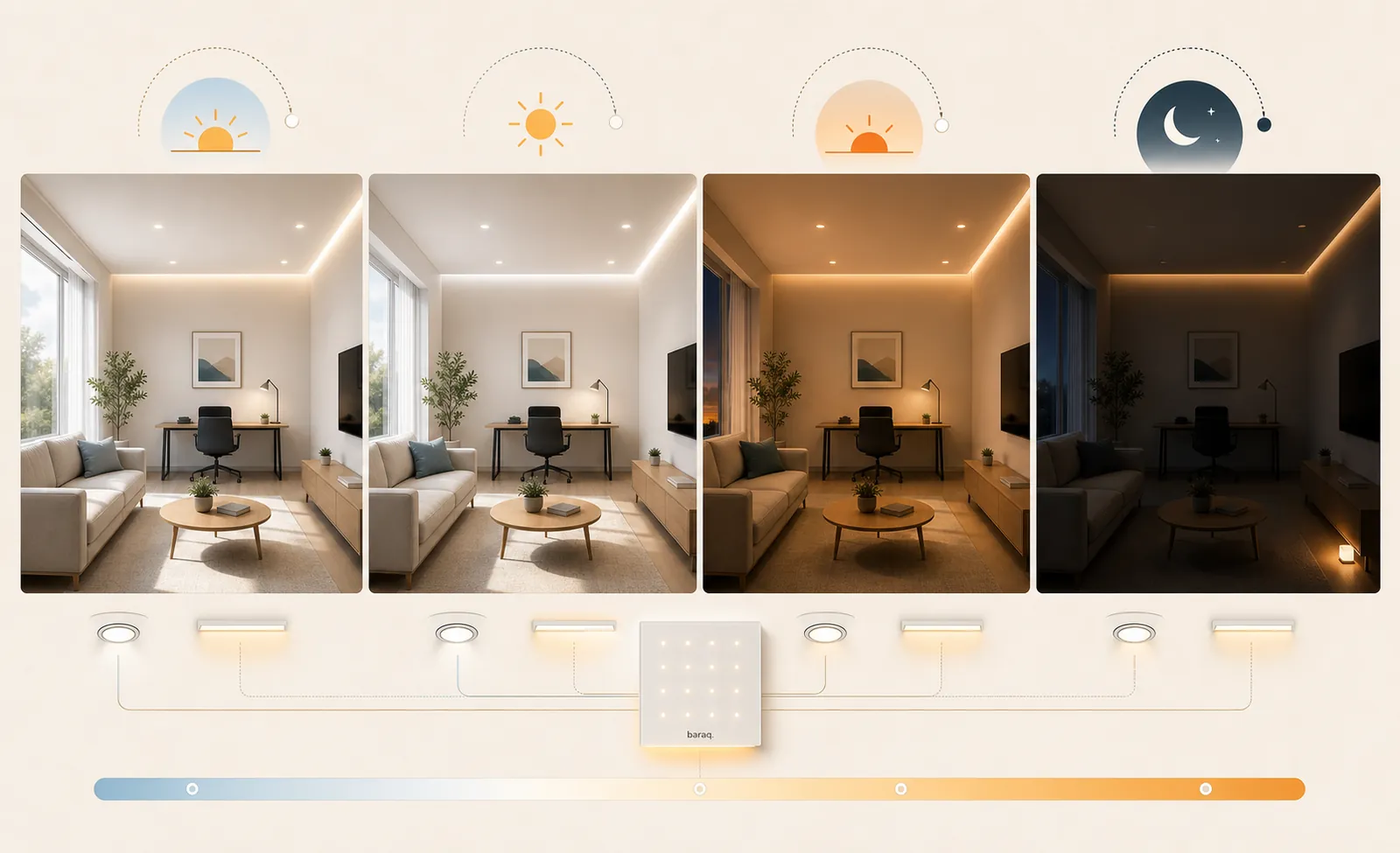
Morning, day, evening, night
During the day, more light usually makes sense. It helps you find your way, keep active and work. In the evening, on the other hand, most people prefer lower brightness and a warmer tone that feels less harsh.
At night, the ideal light is one that doesn’t disturb. A faint guide mode in the hallway or the bathroom gets you through the house without the whole space lighting up at full brightness.
Comfort is more than a technical spec
Colour temperature is often described in kelvins. What matters more to you, though, is how it feels: does the room feel businesslike, cosy, harsh or calm?
- Morning: brighter light to start the day.
- Cooking and work: neutral, practical light.
- Evening: a warm, dimmed scene for relaxing.
- Night: a faint guide light so you can move about safely.
What the circadian rhythm is
The circadian rhythm is our internal body clock. Over a cycle of roughly 24 hours it helps govern the switch between sleep and wakefulness, body temperature, the production of hormones such as melatonin and cortisol, and other daily processes in the body.
This internal clock responds mainly to light and darkness. Morning daylight helps the body recognise the start of the active part of the day. In the evening, by contrast, it makes sense to dim the lights, cut down on harsh cool light and let the home settle gradually into a calmer mood.
Why the circadian rhythm matters
- Recovery: a regular rhythm helps the body keep the active day and the night’s rest apart.
- Energy: it supports alertness during the day and a natural wind-down in the evening.
- Comfort: your home doesn’t feel the same all day; its mood changes with what you need at the time.
Three steps to keep your body clock in step with the day
- Morning light: after you wake up, natural daylight helps tell your body the day has started.
- Evening dimming: at least three hours before bed, it’s worth cutting down on harsh cool light, dimming the lighting and choosing a warmer scene.
- Regularity: getting up and going to sleep at similar times helps your body clock keep a steadier rhythm.
Health effects: a cautious but sensible view
Light affects our daily rhythm. Expert sources agree that what matters most is the timing, intensity and spectrum of the light. During the day it’s good to have enough light; in the evening, it’s better to calm it down.
That doesn’t mean a light bulb on its own will fix your sleep. It means that badly designed lighting can be needlessly disruptive in the evening, and well-designed lighting can better support the household’s natural routine.
Why a smart home should handle it
Setting lights by hand rarely lasts. If you have to think every evening about which shade of white to pick, the system soon turns into just one more control to fiddle with.
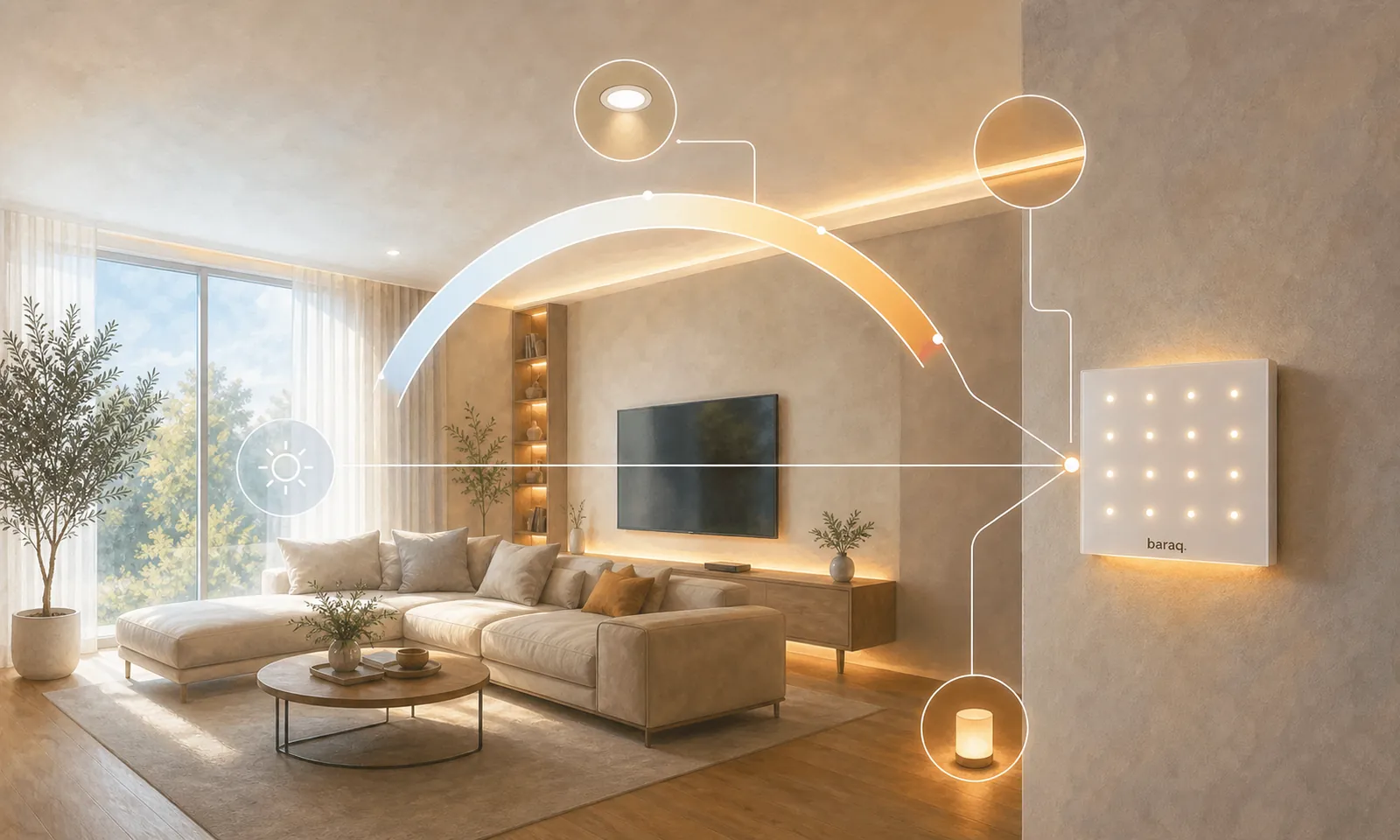
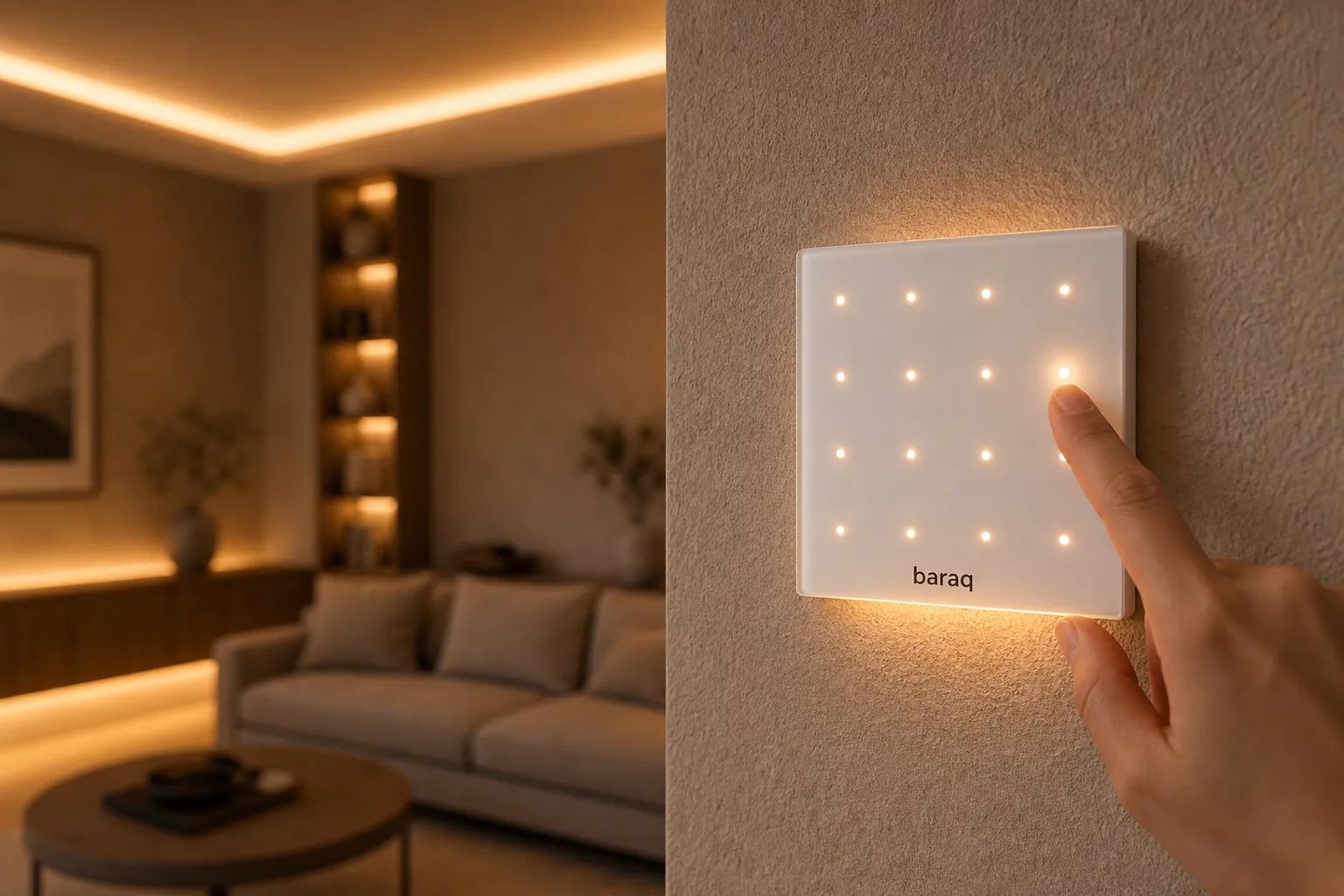
That’s why adjustable colour temperature makes most sense in scenes. ioSWIPE can start a ready-made mode with one touch. Automation can take into account the time, presence, daylight and the particular room.
A practical day in a smart home
In the morning the kitchen lights up brighter and more neutral. During the day the work corner keeps practical light. In the evening the living room switches to a warmer scene and dims the indirect lighting. At night, movement brings on nothing more than a faint strip of guide light.
The result isn’t more complicated controls. The result is less thinking about lights and a more natural mood at every time of day.
When to sort it out
The best time is before the electrical design. That’s when it’s decided which circuits should be dimmable, where the controls go and which scenes make sense for the house. The lighting plan has to be closed before the rough-in at the latest, because every light needs its own line.
Smart lighting isn’t just about switching a light on from an app. It’s a way for the house to feel more natural at every time of day.
Sources
- CIE: Integrative Lighting Position Statement
- PLOS Biology: Recommendations for daytime, evening, and nighttime light exposure
- Scientific Reports: The effects of short-term light exposure on subjective affect and comfort are dependent on the lighting time of day
- U.S. Department of Energy: Tunable lighting studies